The video file “Checon Ramirez.sd_3.mp4” presents a multi-angle compilation documenting a massive explosion and its immediate aftermath. A towering plume of dense, dark black smoke rises aggressively into the clear, bright blue sky from an impact site. The sky is completely devoid of natural clouds, making the thick, menacing smoke stand out with sharp contrast. In the top-left panel of the video grid, the billowing smoke is captured rising behind a suburban parking lot. Several modern cars, including white and dark sedans, are parked neatly in rows within this designated asphalt area. A small brick building with a reddish-brown tiled roof is visible on the right side of this specific frame. A thin, straight white vapor trail left by a high-altitude aircraft cuts horizontally across the distant upper horizon. This aviation trail suggests that flight activity was actively occurring in the area prior to the sudden disaster.
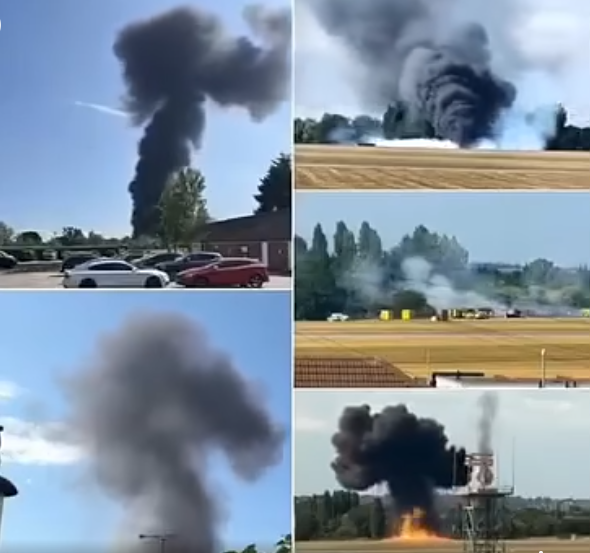
The smoke cloud expands dramatically as thermal energy pushes the dark carbon particles higher into the air. In the bottom-left panel, a similar distant perspective is filmed from another ground location nearby. A dark metal street lamp pole stands vertically in the immediate foreground of this lower-left viewpoint. Green leaves and foliage from local trees brush against the very bottom edge of this frame, framing the scene. The right side of the video layout is split horizontally into three separate, smaller rectangular panels for comparison. The top-right panel offers a much closer look at the turbulent source of the thick, dark smoke column.
Billows of lighter white smoke mix with the heavy black plume near the ground level of the crash site. The middle-right panel reveals an expansive, flat airfield covered entirely in dry, golden-brown grass or crops. Several emergency response vehicles are stationed out in the open field to manage the escalating crisis. At least two bright yellow trucks, which resemble airport fire tenders, are positioned near the center of the zone. These emergency vehicles have their warning lights flashing continuously to signal a dangerous situation to others. A dense line of green trees marks the outer boundary of the airfield in the background of the field.
The bottom-right panel captures the exact moment a secondary blast or violent fuel flare-up occurs on the ground. A bright orange flash of fire bursts fiercely at the absolute base of the rising smoke column. This intense fiery burst indicates that a large amount of highly flammable aviation fuel is actively burning. A tall metal lattice tower stands prominently in the right foreground of this final bottom-right frame. This structure strongly resembles a communications tower or an airfield meteorological station used for data collection. A dark, cylindrical piece of specialized equipment is mounted securely on the very top of this metal tower.
The audio track of the video clip begins with a loud, deep, rumbling explosion sound that echoes. Immediately following this blast, emergency vehicle sirens begin to blare loudly and continuously through the airwaves. The persistent wailing of the sirens underscores the extreme severity and urgency of the unfolding situation. The video relies on compiled eyewitness footage to show the catastrophic event comprehensively from various distances. The immense scale of the smoke plume indicates a very high-impact accident, likely involving a downed aircraft.
The dry grass in the open field appears highly vulnerable to catching fire from the intense radiated heat. The dense, opaque smoke completely obscures whatever object or structure is burning at the core of the fire. The local wind seems relatively calm because the smoke column rises almost straight up into the atmosphere. The top edges of the spreading smoke cloud slowly start to disperse into a lighter grey color. This video provides a detailed, multi-perspective documentation of a sudden and severe aviation disaster as it happens.
The close proximity of the residential parking lot suggests there is a potential danger to nearby civilians. The responding emergency teams appear to keep a safe, calculated distance from the active, unpredictable fire zone. The entire scene unfolds under bright, direct daylight conditions, making every detail highly visible to the cameras. No people are seen running, walking, or panicking in any of the provided footage panels. The visual focus remains entirely on the violent, natural progression of the thick fire and expanding smoke.
Each camera angle remains relatively steady, indicating they were filmed carefully on mobile devices or fixed tripods. The grid layout allows viewers to observe the event from both distant vantage points and close-up angles. The thick black smoke continues to pump out aggressively from the ground without showing signs of slowing down. The orange flames flicker intensely for a moment before being completely swallowed by the expanding dark cloud. This video clip is quite short but captures the immediate, chaotic aftermath of the disaster perfectly. The presentation format resembles a breaking news broadcast compiling crowd-sourced videos of a major public event. The footage cuts off abruptly while the emergency sirens are still echoing loudly across the empty airfield.